

Most people think of a trek as a journey from one destination to another.
The Himalayas tell a different story.
With every few hundred meters of elevation gained, the landscape begins to change. Temperatures become cooler, forests transform, wildlife adapts, and even the air feels different. By the time you reach Annapurna Base Camp, you’re no longer walking through the same environment where your adventure began.
That’s what makes the Annapurna Base Camp Luxury Trek so remarkable.
Instead of exploring a single landscape, you’re moving through several distinct ecological zones, each with its own climate, plants, animals, and natural character.
It’s almost as if five different worlds have been carefully stacked on top of one another.
Let’s discover what happens as you climb higher.
Natural World One: The Subtropical Gateway
The lower elevations of the trek introduce you to a surprisingly lush environment.
Warm temperatures and abundant rainfall create ideal conditions for dense forests, fertile farmland, and vibrant vegetation.
The trails wind through villages surrounded by terraced fields, while bamboo, oak, and broadleaf trees provide shade for much of the journey.
Many first-time visitors are surprised by how green the Annapurna region feels.
The towering snowy peaks may dominate postcards, but the adventure actually begins in a landscape bursting with life.
A Forest That Never Feels Quiet
These forests are home to an incredible variety of birds, insects, and small mammals.
Streams flow beside the trail, moss covers ancient stone walls, and sunlight filters through thick tree canopies throughout the day.
The rich biodiversity found here forms an important part of the Annapurna Conservation Area, Nepal’s largest protected conservation region.
This lower ecosystem provides the perfect foundation for everything that follows higher in the mountains.
Natural World Two: The Temperate Forest Belt
As the trail gains elevation, subtle changes begin to appear.
The air feels cooler.
Trees become more widely spaced.
Certain plant species gradually disappear while others become increasingly common.
Without realizing it, you’ve entered a different ecological zone.
This temperate forest environment supports a diverse mix of rhododendron, maple, fir, and pine trees, creating landscapes that change dramatically with the seasons.
During spring, flowering rhododendrons transform entire hillsides into brilliant displays of red, pink, and white.
In autumn, cooler temperatures add golden tones to the forests before winter arrives.
A Home for Remarkable Wildlife
These forests aren’t just beautiful—they’re biologically important.
Although many animals remain hidden from view, the region supports species such as Himalayan monals, musk deer, langurs, and numerous mountain birds.
Patient trekkers may notice movement high in the trees or hear birds calling from the forest long before they spot them.
One of the reasons the Annapurna Base Camp Luxury Trek feels so immersive is that you’re walking through habitats where wildlife continues to thrive alongside carefully managed tourism.
Natural World Three: The Alpine Transition
Eventually, the forests begin to thin.
Large trees become less common.
Shrubs replace dense woodland.
Rocky slopes start dominating the landscape.
This gradual transition marks the beginning of the alpine environment.
The change isn’t sudden.
Instead, nature carefully reshapes the scenery as altitude increases and conditions become more challenging for plants to survive.
Why Trees Can No Longer Grow
As elevation rises, temperatures decrease and growing seasons become shorter.
Strong winds, thinner soils, and colder winters limit the ability of large trees to establish themselves.
Instead, hardy alpine plants adapt to these demanding conditions by staying low to the ground, conserving energy, and growing during the brief warmer months.
This shift creates one of the most dramatic visual transformations along the trek.
The enclosed feeling of walking through forests gives way to wide-open valleys where surrounding mountains become the main focus.
For many travelers, this is the moment when the true scale of the Himalayas begins to reveal itself.
More Than Just Changing Scenery
It’s easy to think these landscapes exist simply to create beautiful views.
In reality, every ecological zone plays an important role.
Forests help regulate water systems.
Mountain plants stabilize fragile slopes.
Wildlife contributes to healthy ecosystems that have developed over thousands of years.
As you continue climbing, you’re not simply gaining altitude.
You’re witnessing how nature responds to changing climate, terrain, and environmental conditions.
Few journeys allow travelers to experience so many natural transitions within a single adventure.
That’s one reason the Annapurna Base Camp Luxury Trek offers far more than spectacular mountain scenery—it provides a rare opportunity to observe Himalayan ecosystems unfolding step by step.
Natural World Four: The High Mountain Environment
Beyond the alpine zone, the landscape becomes even more dramatic.
Vegetation grows sparse.
Rock, ice, and snow begin to dominate the surroundings.
The air feels noticeably thinner, temperatures fluctuate quickly, and weather conditions can change within a short period.
Life still exists here—but only species specially adapted to these demanding conditions can survive.
Small alpine grasses, hardy mosses, and resilient lichens cling to rocky surfaces where larger plants cannot grow.
Although the environment appears harsh at first glance, it remains a living ecosystem carefully balanced by nature.
Natural World Five: Inside the Annapurna Sanctuary
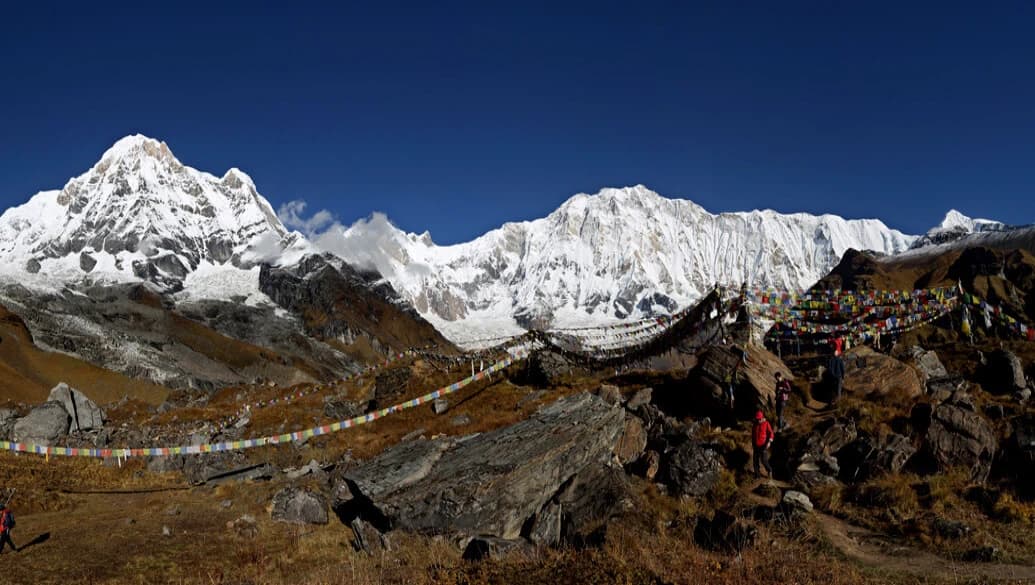
The final stage of the journey leads into one of the Himalayas’ most remarkable natural amphitheaters.
The Annapurna Sanctuary is surrounded by towering peaks that rise dramatically on every side, creating a unique high-altitude basin unlike anywhere else in Nepal.
Here, glaciers, ancient rock formations, and snow-covered summits define the landscape.
Standing in the sanctuary feels different from standing on a viewpoint.
You’re no longer looking at the mountains from a distance.
You’re surrounded by them.
This remarkable setting is one of the defining highlights of the Annapurna Base Camp Luxury Trek, offering an unforgettable perspective on the scale and beauty of the Himalayas.
Experiencing Nature With Local Expertise
Walking through multiple ecosystems becomes even more rewarding when you understand what you’re seeing.
Experienced local guides explain how the landscape changes with altitude, identify native plants, share knowledge about regional wildlife, and help visitors appreciate details that are easy to overlook.
If you’re planning the Annapurna Base Camp Luxury Trek, choosing a trekking company that values environmental awareness and local expertise can greatly enrich the experience.
Mountain Magic Treks combines experienced guides, comfortable accommodations, and thoughtfully designed itineraries that allow travelers to explore the Himalayas while gaining a deeper understanding of the region’s extraordinary natural heritage.
Why Every Meter Tells a Different Story
Most adventures take you to one destination.
The Annapurna Base Camp Luxury Trek takes you through a series of natural worlds, each connected by elevation rather than distance.
You begin among lush subtropical forests alive with birdsong and flowing rivers.
You continue through cool temperate woodlands rich in seasonal color and Nepal biodiversity.
Higher still, alpine meadows give way to rugged mountain slopes where only the toughest plants and animals survive.
Finally, you enter the breathtaking Annapurna Sanctuary, surrounded by some of the highest peaks on Earth.
Each stage reveals how climate, altitude, geology, and wildlife work together to create one of the planet’s most diverse mountain landscapes.
That’s what makes this journey so memorable.
You aren’t simply walking toward a famous base camp.
You’re traveling through a living classroom where every step introduces a new ecosystem, every elevation reveals another chapter of Himalayan nature, and every meter brings a deeper appreciation for the remarkable world that exists within the Annapurna Base Camp Luxury Trek.